
I know what you’re thinking, Jurassic Park? What can running around in the rain while being chased by prehistoric animals teach us about love? Well, let’s dive into it. Don’t worry, no spoilers this time.
Right before I started the Love In Film series, I was brainstorming with someone and jokingly said, “Maybe I should analyse love as shown in Jurassic Park.” We both laughed. But then I had one of those quiet hmmm moments, because the more I thought about it, the more it made sense.
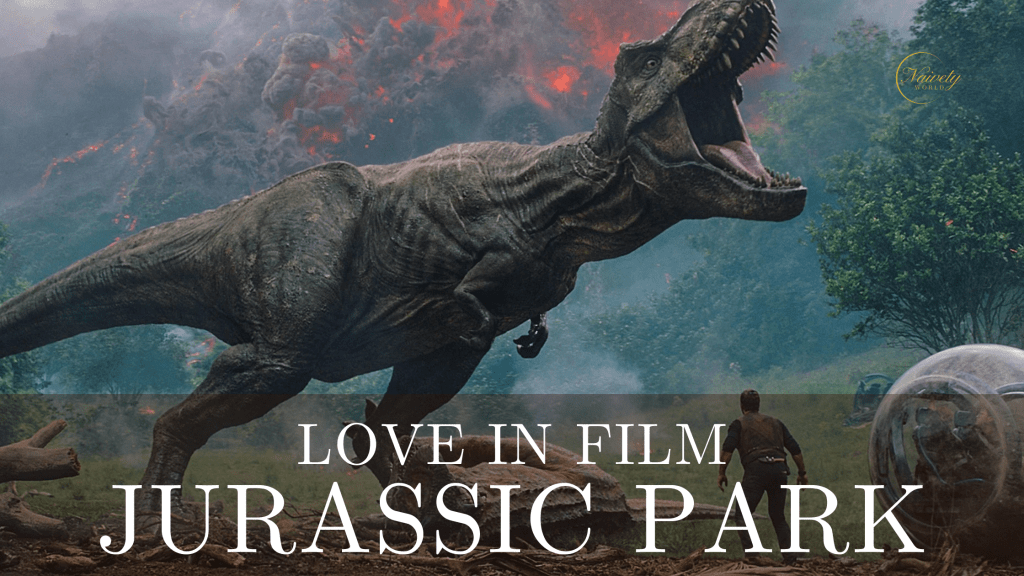
The entire park is a creation born of John Hammond’s love for science, discovery, and his own grandchildren. His drive is rooted in wonder and the urge to build something amazing that would make people feel awe again. But love has layers, and Hammond’s dream, while pure in intention, became dangerous because he tried to control it, contain it, and brand it. The same love that fueled him was his undoing.
Every character in Jurassic Park reflects a different version of this struggle. Alan Grant is a man who finds comfort in the certainty of the past. His world is orderly, predictable, and safely distant from the messiness of emotion or human unpredictability. He resists change because children, relationships, and chaos all threaten the calm structure he has built around himself. Ellie Sattler loves the living world. She doesn’t just study it, she listens to it, adapts to it and protects it. Malcolm is fascinated by chaos and by life’s refusal to obey formulas. He loves being the one who sees the pattern in the unpredictable, who understands that control is an illusion.
Each of them has a certain way they move through the world. They’re all taken in by the wonder of Hammond’s creation and connect with it in different ways depending on their personalities. Which is the same thing we do when we come across something new and unpredictable. We try to fit it into a box so we can have some level of control over the outcome. But life, love, and dinosaurs don’t fit in boxes. In Jurassic Park, the dinosaurs aren’t villains; they’re simply alive, oblivious to the expectations put on them, to behave and entertain. It’s not in their nature.
Across the series, we see love evolving. The first film is about creation and consequence. The second, The Lost World, is about protection. Malcolm returns not for fame but for Sarah, and later for his daughter. Love becomes the willingness to face chaos for someone you care about. In Jurassic Park III, Grant’s emotional growth becomes more personal. He goes from isolation to connection, risking his life for a child. The man who once said he didn’t want kids ends up showing what love looks like when it stops being theoretical and starts being lived.
When the story shifts into the Jurassic World era, everything feels colder. The dinosaurs are no longer wonders; they’re products. People have grown numb to what was once extraordinary, and the park responds by manufacturing bigger, meaner dinosaurs to keep audiences interested. You know how that went. But that’s what happens when we take what’s special for granted, when awe becomes routine, and wonder is treated like a resource to be mined.
The world of Jurassic World reflects what happens in relationships, art, even life itself. The more familiar something becomes, the more we feel the need to reinvent it, to amplify it, to make it louder. But in doing so, we lose the quiet truth that made it beautiful in the first place.
But even in that artificial environment, real connection still finds a way to exist. Owen’s bond with Blue, the raptor, becomes the emotional core of the newer films. Their relationship is built on trust, a quiet understanding between two beings who recognize each other’s nature.
By the time we reach Jurassic World Dominion, everything has changed. Dinosaurs now roam freely. Humanity no longer has the option to contain them. The story at that point isn’t about domination or escape anymore, it’s about coexistence. After decades of running, chasing, and rebuilding, the series ends with acceptance that what we once feared, we must now learn to live alongside.
That’s what gives the entire saga its emotional depth. Beneath all the chaos and spectacle, it has always been about love. Love that creates, love that corrupts, love that learns. That’s why the line “Life finds a way” is more than a catchphrase. Love, like life, finds a way through failure, through loss, through extinction. It adapts. It survives. It forces us to grow.
Because in the end, whether it’s a dinosaur or another human being, the same truth remains: love isn’t control. It’s the courage to let others choose their path, and to heal yourself instead of holding on to what you can’t contain.
 Naivety World
Leave a comment