Welcome back to the Love in Film series.
Today, we’re talking about Shrek, the 2001 animated film that hides its emotional clarity behind layers of absurdity.
At its simplest, Shrek is about an ogre who wants to be left alone, a princess living under a curse, and a loudmouthed donkey who refuses to leave anyone alone. But beneath the humor and the parody, the film is a sharp examination of how self-image shapes the way we love and connect.
The movie Shrek is a story about two people, who have been taught they’re too much or not enough, slowly learning how to let themselves be seen. Despite its fairytale setting, Shrek treats love with surprising realism. It rejects the idea of instant destiny and instead shows connection forming through shared experience, awkward moments, and unguarded conversations.

Shrek’s relationship with love is built on self-protection, rooted in a fear of unworthiness. He wants connection but is convinced he doesn’t deserve it. He preempts rejection before it can happen, hides behind sarcasm and solitude, and filters every moment through the assumption that someone like him doesn’t get chosen. His real conflict isn’t with Fiona, it’s with his own narrative about himself.
Fiona, on the other hand, is wrestling with a different kind of fear: the fear that her true self disqualifies her from the role she was raised to play. She thinks she must stay in princess form to be lovable, even though that version of her isn’t honest or sustainable. The curse becomes a metaphor for every identity we hide because we think it makes us less worthy.
“I’m a princess, and this is not how a princess is supposed to look.”
What makes their romance compelling is how naturally it forms once they stop pretending. Their connection grows while roasting weed rats, sharing stories, and laughing at each other’s bad table manners. These scenes aren’t glamorous, but they’re intimate in ways not often shown in fairy tales.
And then there’s Lord Farquaad.
Farquaad represents the opposite approach to love, one based entirely on image, status, and control. He wants a princess not for emotional connection but for legitimacy. Everything about him is curated: his kingdom, his castle, his appearance, even his romantic choices. Where Shrek and Fiona struggle with the fear that their real selves are unlovable, Farquaad avoids having a real self at all. He hides behind power the same way they hide behind their insecurities.
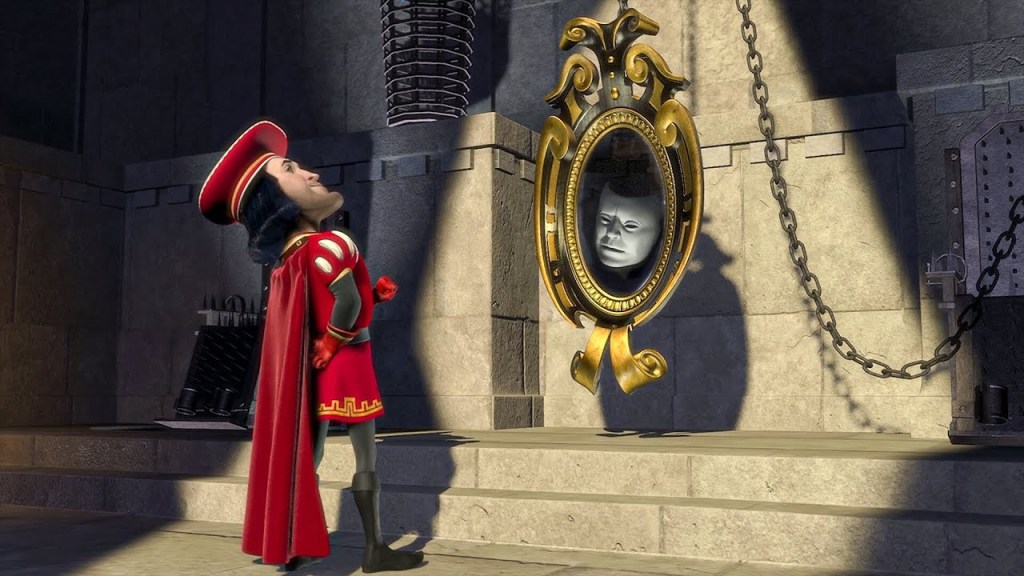
Farquaad’s character shows what it looks like when someone designs their life to avoid vulnerability altogether. If Shrek and Fiona fear they’re not enough, Farquaad fears being perceived as anything less than superior. His emotional avoidance highlights the courage in Shrek and Fiona’s arcs. He makes their vulnerability visible.
Viewed through the Naivety World lens, Shrek reveals a truth we don’t like admitting, that we often judge ourselves far more harshly than anyone else would. Both Shrek and Fiona believe their real selves are unlovable, and that belief becomes the biggest barrier between them. The film reminds us that many heartbreaks don’t come from rejection but from the assumptions we make about ourselves before anyone else gets the chance to choose us.
And while Shrek is wrapped in comedy, the storytelling is intentional. The humor is a smokescreen that lowers our defenses so the emotional moments can resonate without feeling heavy-handed. Donkey serves as the catalyst, pushing both characters toward truths they’d rather avoid. The film constantly contrasts performance with authenticity, the fairytale version of Fiona versus the one who belches around a campfire, the isolated ogre versus the man capable of tenderness.
In the end, Shrek is a grounded portrait of two people unlearning the belief that love is something earned through perfection. It shows that love finds its way when we finally stop hiding who we are.
 Naivety World
Leave a comment